Client platform
Human OS
A living interface to an author’s work, voice and ideas across time.
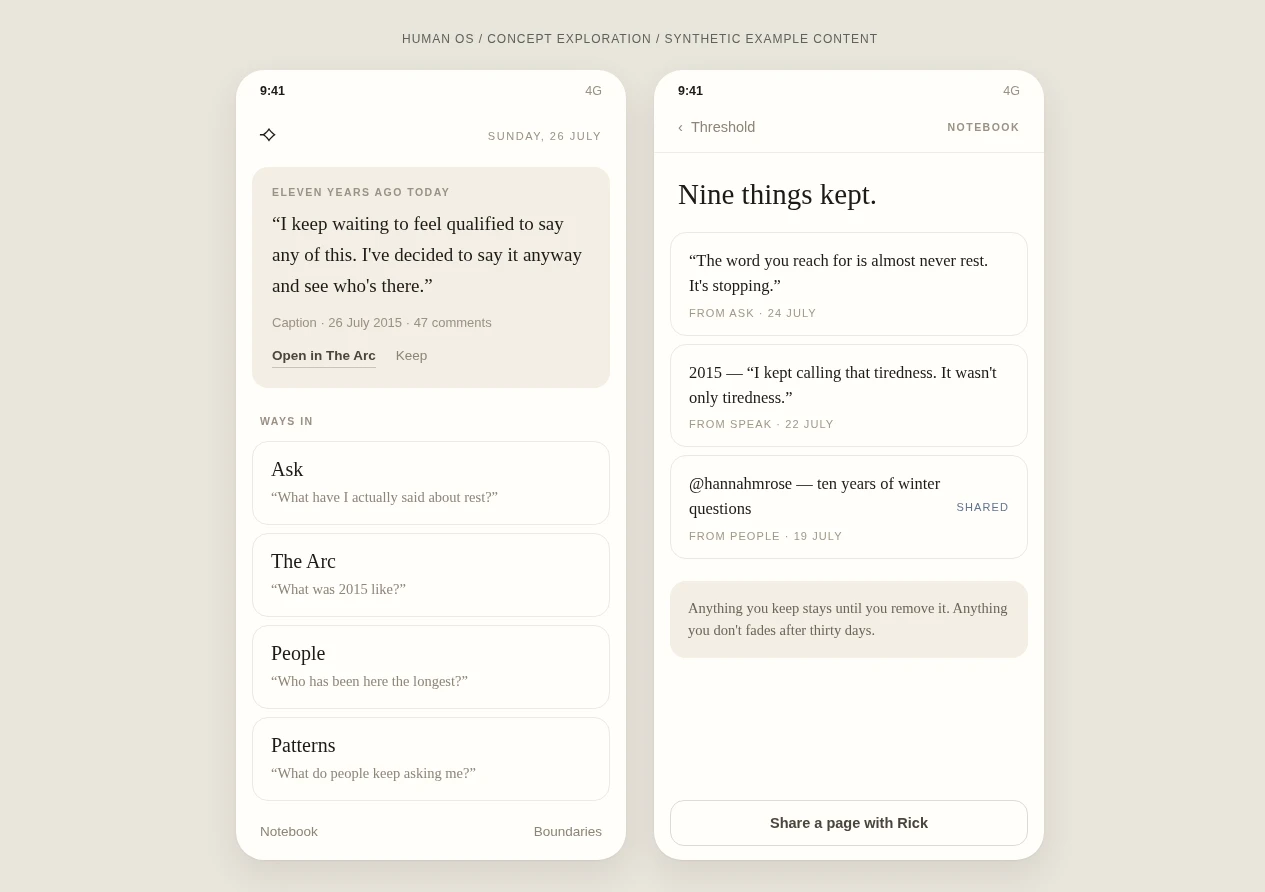
An invitation into the archive
The Threshold offers a piece of earlier writing before asking what to do next. The Notebook gives discoveries somewhere to stay. Original concept screens with synthetic example content, not client-runtime captures.
View full sizeBuilt for my client Olivia, Human OS turns an authored archive into a place to explore. She can ask questions of her work, follow its development through time, revisit earlier writing and keep what she discovers. Responses lead back to their sources.
The platform brings together a timeline, era-bounded conversation, daily resurfacing, a notebook, patterns in reader exchanges and carefully controlled invitation workflows. The experience was designed around her creative practice, with different rooms for different kinds of attention.
This is separate from Agent OS, my personal agent-governance experiment. A public Human OS demonstration will use a wholly synthetic person and corpus; the client platform and its data remain private.
Private client platform with implemented exploration and invitation surfaces. Public synthetic demonstration pending.
More views (2)
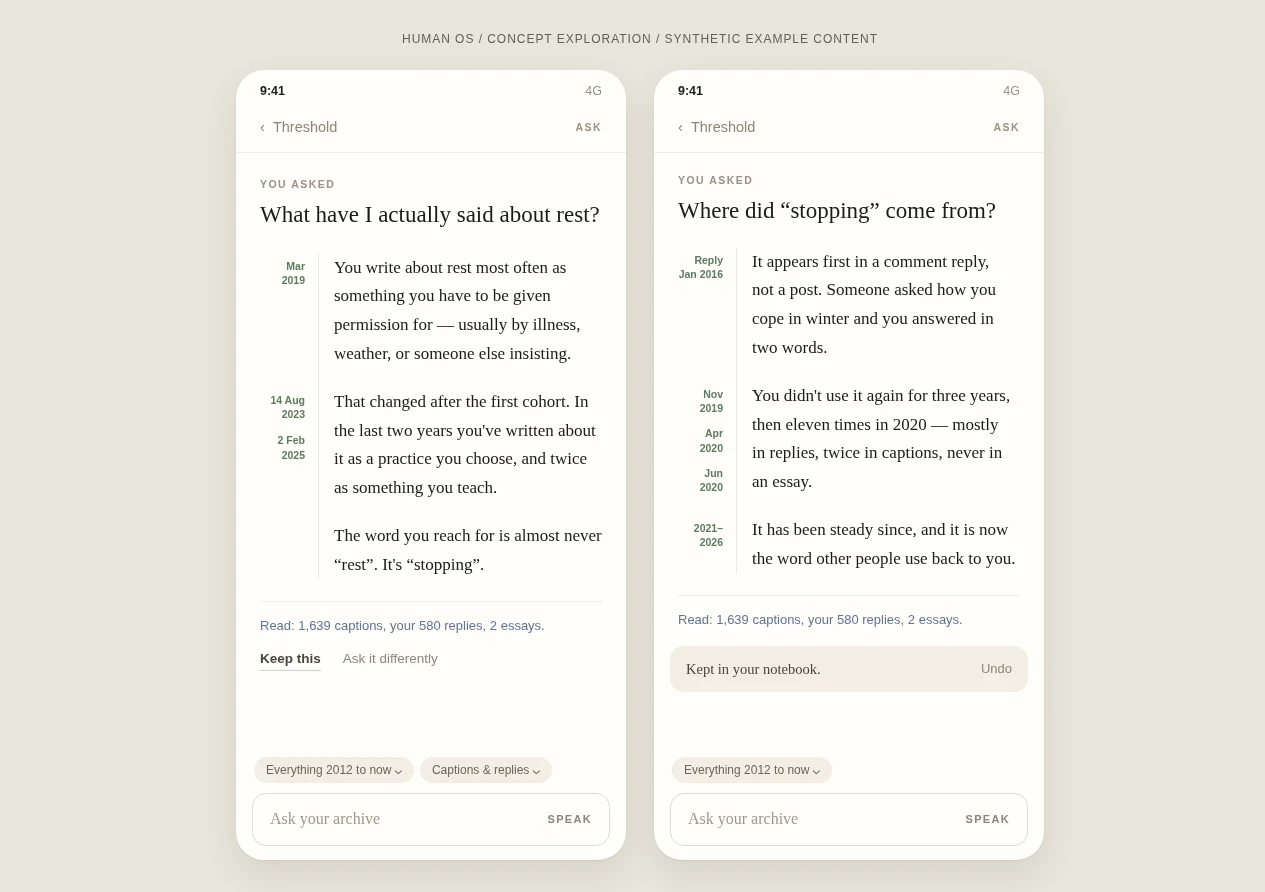
An answer with a visible past
Dates sit beside the answer rather than interrupting every sentence. A follow-up question can trace a phrase back through the archive; keeping the answer is a separate choice. Synthetic examples.
View full size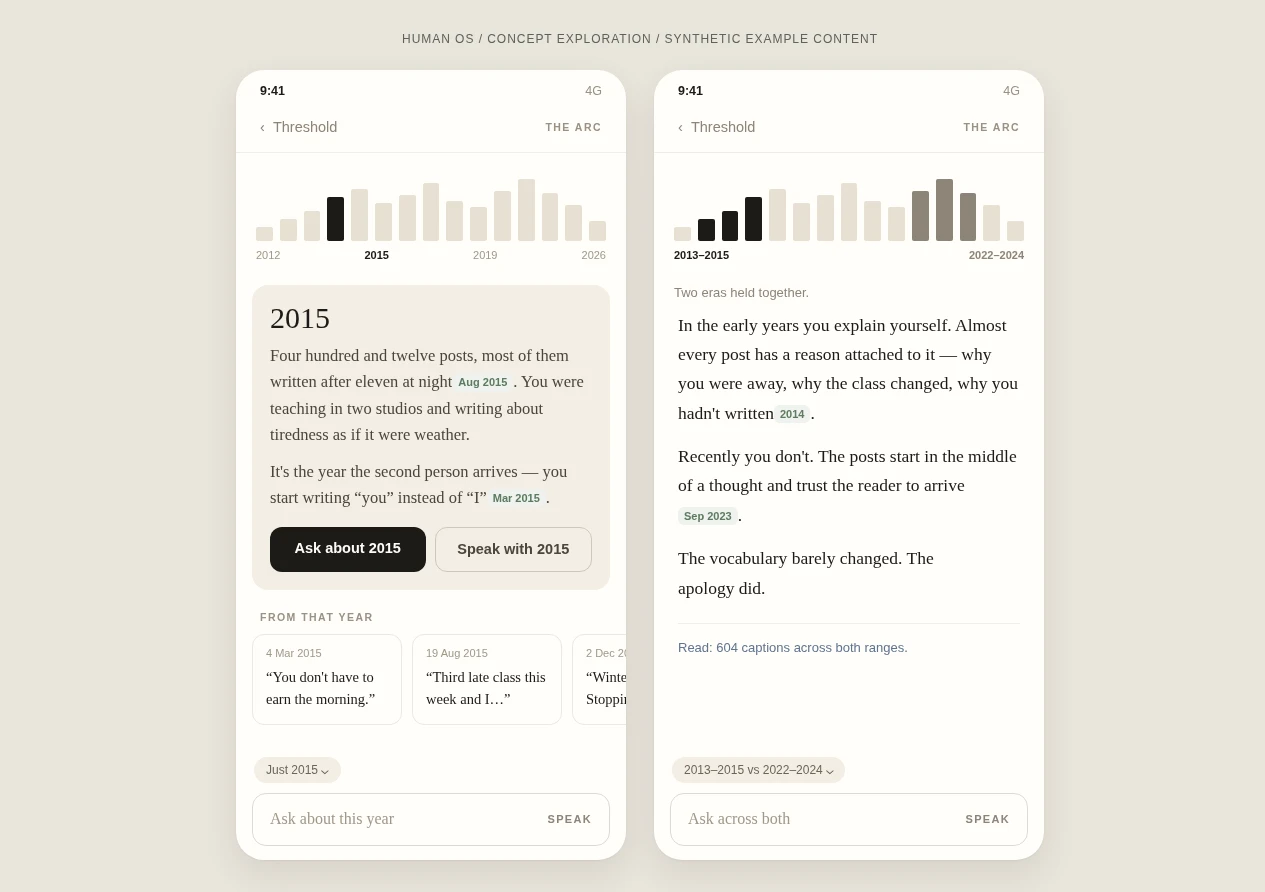
Two periods, held together
The Arc moves from a year to its individual pieces, or compares two periods of writing. The reader can inspect the sources behind the interpretation. Synthetic examples.
View full sizeTechnical detail
Architecture checked against the private platform’s routes and corpus, inference-validation, resurfacing and persistence code. No client corpus, correspondence or participant records are included here.
A personal archive as an interface
The mobile-first platform organises access into distinct rooms: Ask, The Arc, People, Patterns and a Notebook, with invitation and source-management surfaces alongside them. The Arc presents work through time; Speak offers an explicitly bounded encounter with an earlier period of the author’s writing. This is a generated interpretation grounded in that period, not a recovered memory or a claim to reproduce the person.
Following one question through the system
Suppose the reader chooses an earlier year and asks what the author was writing about. The selected period limits the material supplied to the model. That material carries references to a particular version of the archive, so a citation can be resolved against the same source set used to produce the answer. Validation checks the returned references and quotations against that set. The reader can then open a source sheet to inspect the original passage. Those checks support traceability; they do not establish that every interpretation is correct.
Corpus contracts and provenance
The corpus layer separates snapshot resolution, structured records and pack artifacts. Queries carry snapshot IDs; filesystem artifacts use integrity checks. Scoped packs supply the model context, and generated citations are checked against the supplied source inventory. Quote validation checks text against those sources. Source sheets let the reader inspect the material behind a response.
Different kinds of persistence
Daily resurfacing is a deterministic function of date and corpus, preferring anniversaries without a scheduled model call. Speak’s conversation is held in memory. Notebook items are deliberately kept and have explicit share and take-back actions. Store interfaces support filesystem and Convex implementations; these are distinct persistence choices, not a claim that all conversations are automatically retained.
From discovery to an invitation
The invitation surface combines an approved source pack with voice rules and an editable draft. Its state machine distinguishes preparation from a human confirmation that something was sent. Source-pack records use supersession rather than silently rewriting earlier facts. The wider teaching-integration specification contains additional planned capabilities; those are not presented as delivered features here.
Stack / components
Next.js, React, TypeScript, scoped corpus packs, validated model output, filesystem and Convex storage adapters